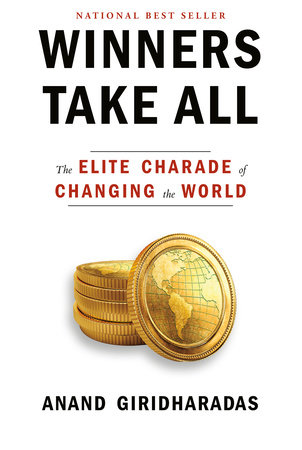
An insider's groundbreaking investigation of how the global elite's efforts to "change the world" preserve the status quo and obscure their role in causing the problems they later seek to solve.
Former New York Times columnist Anand Giridharadas takes us into the inner sanctums of a new gilded age, where the rich and powerful fight for equality and justice any way they can--except ways that threaten the social order and their position atop it. We see how they rebrand themselves as saviors of the poor; how they lavishly reward "thought leaders" who redefine "change" in winner-friendly ways; and how they constantly seek to do more good, but never less harm. We hear the limousine confessions of a celebrated foundation boss; witness an American president hem and haw about his plutocratic benefactors; and attend a cruise-ship conference where entrepreneurs celebrate their own self-interested magnanimity.
Giridharadas asks hard questions: Why, for example, should our gravest problems be solved by the unelected upper crust instead of the public institutions it erodes by lobbying and dodging taxes? He also points toward an answer: Rather than rely on scraps from the winners, we must take on the grueling democratic work of building more robust, egalitarian institutions and truly changing the world. A call to action for elites and everyday citizens alike.
KIRKUS REVIEW
Give a hungry man a fish, and you get to pat yourself on the
back—and take a tax deduction.
It’s a matter of some irony, John Steinbeck once observed of the
robber barons of the Gilded Age, that they spent the first two-thirds of their
lives looting the public only to spend the last third giving the money away.
Now, writes political analyst and journalist Giridharadas (The True
American: Murder and Mercy in Texas, 2014, etc.), the global financial
elite has reinterpreted Andrew Carnegie’s view that it’s good for society for
capitalists to give something back to a new formula: It’s good for business to
do so when the time is right, but not otherwise. Moreover, business has
co-opted philanthropy, such that any “world-changing” efforts come with a
proviso: “if you really want to change the world, you must rely on the
techniques, resources, and personnel of capitalism.” Philanthropic initiatives
to effect social change are no longer the province of public life but instead
are private and voluntary, in keeping with free market individualism.
Naturally, there’s a layer of consultants and in-house vice presidents to
manage all this largess, which hinges on the premise that things aren’t so bad
and just need to be nudged along. The author memorably calls this process
“Pinkering,” after the ameliorist-minded psychologist Steven Pinker. “It beamed
out so many thoughts about why the world was getting better in recent years,”
Giridharadas writes of one initiative, “that its antennae failed to detect all
the incoming transmissions about all the people whose lives were not improving,
who didn’t care to be Pinkered because they knew what they were seeing.” So
what’s so bad about private giving? Answers the author, when a society elects
to help, it expresses democratic values with an eye to equality, while private
giving is inherently unequal, a power relation between “the giver and the
taker, the helper and the helped, the donor and the recipient.”
A provocative critique of the kind of modern, feel-good giving
that addresses symptoms and not causes.
ANAND GIRIDHARADAS is the author of The True American and India Calling. He was a foreign correspondent and columnist for The New York Times from 2005 to 2016, and has also written for The Atlantic, The New Republic, and The New Yorker. He is an Aspen Institute fellow, an on-air political analyst for MSNBC, and a former McKinsey analyst. He teaches journalism at New York University and has spoken on the main stage of TED. His writing has been honored by the Society of Publishers in Asia, the Poynter Fellowship at Yale, and the New York Public Library's Helen Bernstein Award. He lives in Brooklyn, New York.
Mrs Baksh came to St. Stanislaus from Queen's College on February 3, 2014 as Deputy Principal specializing in the teaching of Geography.and is particularly interested in Curriculum Development.
St. Stanislaus College students achieve overall 96% passes at CSEC, CAPE
By Staff Writer
St.
Stanislaus College students attained 96.23% overall passes in this
year’s Caribbean Secondary Education Certificate (CSEC) examinations and
96.03% at the Caribbean Advanced Proficiency Examination (CAPE).
According
to a press release issued by the school, the students’ results at the
2018 CSEC and CAPE continue to maintain the traditional high standards
of the 152-year-old institution.
The
release said Sherlock Langevine was the top CSEC performer with 14
Grade 1 (14 G1s) passes, closely followed by Amarnauth Narain (12 G1s, 3
G2s), Tassia Bacchus (11 G1s, 1 G2), Nathan Hackett (10 G1s), Nectar
Prince (10 G1s, 2 G2s), Eleesha Sanasie (10 G1s, 1 G3), Ryan Khan (9
G1s, 4 G2s, 1 G3), Nia Williams (9 G1s, 4 G2s), Lennox Hopkinson (9 G1s,
1 G2), Skekeria Taitt (9 G1s, 1G2) and Julia Williams (9 G1s, 1G2).
The
top CAPE performers were Rashma Surjnarine (8 G1s, 3 G2s), Reya Persaud
(6 G1s, 3 G2s, 2 G3s), Aleah Marks (4 G1s, 5 G2s), Leshonda Kellman (4
G1s, 3 G2s, 2 G3s), Shaniah Reece (4 G1s, 3 G2s, 2 G3s), Tamara Cummings
(4 G1s, 6 G3s), Chelsea James (3 G1s, 6 G2s). The release noted that
the students achieved perfection with 100 percent passes in the
following CSEC subjects: Caribbean History, Economics, Electronic
Document Preparation and Management, English A, English B, Food and
Nutrition, Geography, Industrial Technology Electrical, Information
Technology, Integrated Science, Mathematics, Office Administration,
Physical Education and Sport, Portuguese, Principles of Business,
Agricultural Science, Social Studies and Technical Drawing.
The
release said the English Department secured the following results:
English A: Grade 1 (83.67%), and Grade 2 (16.33%); and English B: Grade
1(34.88%), Grade 2 (56.98%), and Grade 3(8.14%). The Mathematics
Department, meanwhile, accomplished the following results: Grade 1
(65.17%), Grade 2 (30.34%), and Grade 3 (4.49%).
“The College’s
overall results at the CSEC/CAPE examinations continue to show steady
progress, a reflection of the joint pursuit by the dedicated staff and
the receptive learners of the school’s motto of ‘Aeterna Non Caduca’ –
Not for this life only but for Eternity,” the release added.
Light
It Up! CaribbeanTales Ignites with the Special Preview Screening of HERO
7
Special Presentation Nights| Sept. 5th – Sept. 20th | 30+
Films
Toronto,
August 8th, 2018 – The 13th year of the CaribbeanTales Film Festival opens on WednesdaySeptember 5, 2018 with a special preview screening of Hero:
Inspired By The Extraordinary Life & Times of Mr. Ulric Cross at
the Royal Cinema, 608 College Street at
8:00pm with a red carpet of stars and influencers rolling out at 7:00pm.
Hero
is directed and produced by Frances-Anne
Solomon – founder and CEO of CaribbeanTalesFilm Festival. Women directors, producers and HerStories are featured
prominently in this year’s line-up of the Opening Night Gala and the 7 Special
Presentation Nights:
Sept. 5th-
Opening Night: Trailblazers
Sept. 12th
- Shine Ya Light
Sept. 13th
- Building Bridges (Women of Colour Creators)
Sept. 14th
- Draw Fire: Bajan Invasion
Sept. 15th
- Rise Up: Queer and Here
Sept. 15th-
Shades of Justice
Sept. 19th
- Redemption Tales
Sept. 20th
- Torchsong: Haiti.
“Our
festival theme this year is ‘Light It Up.’ It’s a call to action. A call to
arms. A call to change. A call that’s been ringing out for a long time,” says
Diana Webley, Associate Festival Director. “We are asking our filmmakers to shine
their lights on all the changes in the world, to showcase their vision of
change and to spread their message…to lead the way.”
Opening night film Hero introduces the world
to breakout star Trinidadian actor/artist/musician Nickolai Salcedo (Moving
Parts, Salty Dog) and includes an international supporting cast of
Jamaican-born PeterWilliams (Stargate SG-1, A Winter Tale), St. Lucian/British Joseph Marcell (Fresh Prince of Bel-Air) and Ghanaian Nollywood superstar John Dumelo (A Northern Affair).
Hero
tells the story of Ulric Cross, a Trinidadian trailblazer who made his mark in
history flying fighter planes in World War II to become possibly the most decorated
West Indian Airman. During a time when racism placed roadblocks in the way of
people of African descent, Cross broke down barriers to become a BBC
broadcaster, a lawyer, a judge and a diplomat. He played a central role in the
independence struggles of both Africa and the Caribbean. Hero tells a story that
intertwines archival footage and dramatization. “Ultimately, the story is about us, says Director/Producer
Frances-Anne Solomon, “About who we are as Caribbean people, and as citizens of
the world.”
Other notable films to watch for:
Dancehall’s
Asian Ambassadors
– director: Kaneal Gayle/Sept. 19th
-a
documentary that follows four Japanese women who move to Jamaica after falling
in love with Dancehall music and build their lives and careers on the island
and in its music culture.
Saturday
Night Church
– director: Damon Cardasis/Sept. 15th
-teenager
Ulysses struggles with his gender identity and finds an escape by creating a
world of fantasy filled with dance and music that leads him to a vibrant
transgender community
It
Stays With You: Use of Force by UN Peacekeepers in Haiti – directors:
Cahal McLaughlin & Siobhan Wills/Sept.
20th
-this
film returns to Haiti’s Cité Soleil,
a severely economically depressed neighbourhood in Port-au-Prince to examine
the impact of the 2005-2007 crackdown on criminals that left scores of
civilians dead or injured
CaribbeanTales Film Festival (CTFF) celebrates
the talents of established and emerging filmmakers of Caribbean heritage who
practise their art across the Caribbean Diaspora and worldwide. CTFF presents a
multi-ethnic mix of exciting and dynamic films that showcase diverse and shared
stories and cultures.
CTFF is produced by Caribbean Tales Inc., a
registered Canadian charity. The company’s mandate is to foster and encourage
intercultural understanding and racial equality, through the creation,
marketing and distribution of film, programs, events and projects that reflect
the diversity and creativity of Caribbean heritage and culture.
Introduction
The Ministry of Education’s Strategic Plan (2014-2018) focuses on Science, Technology,
Engineering and Mathematics (STEM) as a critical tool for national sustainable development.
Part of this focus includes finding effective, cost-effective, and fun ways to deliver STEM
education. These efforts are geared towards building scientific literacy at an early age. This is
the third Pueblo Science workshop held in Guyana. It was hosted in collaboration with the St.
Stanislaus College Board of Governors and its Toronto Alumni Association. The workshop
focused on experiential learning with locally-available and low-cost materials. More teachers
from the hinterland (Region 7–9) schools were included in this workshop than in previous years.
These teachers are challenged with sourcing materials for practical work. It is hoped that the
experiments conducted would aid in ways of thinking on how to use available, low-cost
materials inside and outside a science laboratory to do practical work.
Through these experiments, participants learned how to teach concepts in chemistry and
physics. The use of cardboard, marbles, fruits and other available consumables to teach
hands-on science provided them with a new approach in the process of learning this subject. In
particular, the simulation of the Gold Foil experiment was done by teachers for the first time.
This experiment used marbles, locally-made meter rulers and masking tape. This activity was
designed to demonstrate how an experiment can provide information about something that
cannot be seen.(1)
Facilitated by the the expertise of Pueblo Science instructors, this collaboration between the
Science Unit, NCERD, Ministry of Education and St. Stanislaus College provided learning
opportunities for fun and hands-on activities. The integration of science through design thinking
was also demonstrated in most of the activities. A total of 85 participants were trained this year.
Teachers from Regions 7 and 8 participated for the first time. Teachers from St. Ignatius
Secondary participated for the second time. This workshop included the District Education
Officer – Region 9.
Strategies
The Pueblo Science team identified specific areas of the curriculum and linked the identified
experiments to these areas. This was proven to further enhance the learning of the participants
for immediate application in the classroom. While work was conducted in small groups at
various stations, some sessions engaged the entire group of participants. For example, work on
polymers, robotics, engineering design challenges, ice cream making and magic tricks engaged
all of the participants. In some activities the science was intentionally hidden and participants
had to explain their observations before the facilitators provided guidance. This created an
atmosphere of fun learning while simultaneously engaging participants in understanding
concepts. The Pueblo Science team—comprised of professional scientists, engineers and
1 Pueblo Science Manual, 2018 p. 20
educators—provided the appropriate, deep yet multi-faceted expertise that is required to teach a
multi-disciplinary topic such as robotics.
A total of four stations were set up for this workshop. Each station actively engaged the
participants in a blend of theory and practical work. The strategies used revealed how science
could be taught using the scientific method. The 5 E (Engage, Explore, Explain, Elaborate and
Evaluate) instructional model was used which also mirrors the scientific method. This approach
is not usually practiced in the delivery of the science curriculum in schools. In addition, the low
cost of materials for conducting science experiments added much value to this workshop. The
materials were shared with several schools after the conclusion of the workshop so that
teachers can put into practice what they learned in their classrooms.
Station 1 was set up for Chemistry and facilitated by Prof. Scott Browning. At this station, the
microscience chemistry kit was used as part of the activities to conduct the electrolysis of water.
Food batteries were used to show how electrochemical cells work. Prof. Scott encouraged
participants to A.S.K. – “Ac quire Sexy Knowledge”. Station 2 was set up for Physics and
facilitated by Dr. Stanley Wong. Station 3 was set up for Light experiments and was facilitated
by Dr. Mayrose Salvador. Station 4 was the robotics station which was set up for the students.
The facilitators for Station 4 were Dr. Martin Labrecque and Mr. Fuhad Rahman. In addition to
the robotics sessions, the students also worked at Station 1 to conduct electrochemistry
experiments.
Challenges
The late approval of the Pueblo workshop proposal led to challenges in implementation of the
workshop. Negotiations were made for materials to be supplied in advance of payment. The
National Science Coordinator lost facilitation time since meetings and close follow-up with the
Chief Accountant and other administrative staff had to be conducted to facilitate the payment of
the Guyana teachers’ travel on time.
Most of the teachers that were invited from Georgetown were engaged in marking of the
National Grade Nine Examinations and could not attend the Pueblo workshop.
Recommendations and Areas for Improvement
Through interactions with participants, recommendations were made to host the Pueblo
workshop in various regions including the hinterland regions for students and teachers. Planning
for this will need to be done in advance to facilitate all logistical arrangements and timely
release of finances and other critical resources.
A follow up evaluation should be completed by the middle of the upcoming academic year to
determine the level of implementation of the 2018 Pueblo Manual for schools especially in the
hinterland regions.
For sustainability of the program, local volunteer scientists and engineers from for example
University of Guyana can be involved during the workshops. They can be trained by the Pueblo
instructors to help Pueblo Science instructors facilitate the workshops and perhaps later on
deliver their own workshop using Pueblo Science activities.
More significant financial support would be necessary for Pueblo Science to continue providing
workshops in a sustainable manner.
Feedback from Pueblo Science Instructors
The instructors were very happy with the experience and would gladly go back to Guyana again.
Everyone’s highlight was meeting so many dedicated teachers, education professionals and
other individuals who are passionate about improving the education of their students and the
future of Guyana. Our instructors are also very grateful for the cultural presentation of the
teachers during the closing ceremony.
The event was well-organized and the instructors were very thankful that most of the materials
needed for the workshop were already there, sorted nicely in boxes prior to the workshop.
The instructors appreciate the fact that volunteers to help facilitate the workshop were provided.
They recommended that a list of tasks for local volunteers who will help facilitate the workshop
should be created and then communicated to the volunteers before the instructor arrive in
Guyana. Meeting with the volunteers one day before the start of the workshop to discuss the
tasks would be helpful.
The computer room at St. Stanislaus College where the robotics class was held for the student
was not available for the instructors to install needed software prior to the workshop, it was also
opened late on some days. As a result, precious time for teaching was lost.
Feedback from Participants
Sticky notes were used at each station to collect feedback from participants after completing
their stations. These are compiled in Appendix 2. In summary the participants found the
workshop to be interactive and engaging. Concepts were presented simply through the selected
experiments. The competence and motivation of the facilitators stood out in the delivery of the
sessions.
Feedback from STEM Club Assistants
The robotics station – Nicholas Elliot
The robotics station had a turnout of twenty-five (25) students. Over the course of the three
days, students were challenged to build a sturdy robot with wheels. They were also tasked with
orienting sensors in appropriate positions which will help the robot see straight ahead by
detecting colours as well as placing sensors to detect the robot’s lateral proximity to objects.
Upon completion of the construction phase, students were introduced to the basic principles of
programming. The participants were thereafter expected to use this knowledge to create a
program that would allow the robot to traverse a specific path by choosing which colours to
follow. The program should also allow the robot to make sounds as it passed nearby objects.
All students were able to successfully complete the tasks expected of them by the end of the
second day and in light of this, Dr. Martin announced that he will be giving a prize to the group
with the best robot; the parameters being the robot’s ability to traverse a prescribed route, the
robot’s ability to collect a few batteries taped together at the end of the road and its ability to
return home with the load while making sounds as it approximated buildings. As a result, the
morning session of the third day was used to refine the physical and software designs, thereby
allowing their robot to be more efficient and swift in completing the challenge.
All groups managed to design the software and one group was even able to complete the entire
challenge while the others faced difficulty with coming up with a physical design to
accommodate fetching.
Overall, students were successful, engaged and felt motivated by the experience to the point
where they lost track of snack and lunch time. The variety in cultures, experiences and ways of
thinking resulted in a wealth of creative ideas and opinions being brought to the design board,
and in many proposed solutions for the problems they faced during each stage of the process.
Physics station – Masud Lewis
The dedication and ability of Dr. Stanley Wong to fully immerse himself in what he did
demonstrated his joy for his work which was felt by the participants. His competence and ability
to remove any potential barriers of learning created an atmosphere that was highly interactive.
He connected with everyone he taught. (1) Pueblo Science Manual, 2018 p. 20